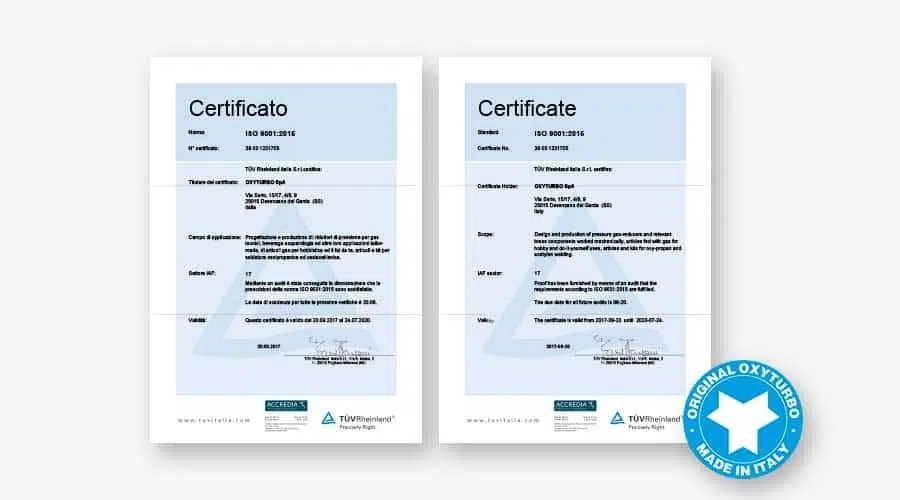
The new edition of the ISO 9001 “Quality Management Systems” standard was released on September 22, 2015 – with a publication date of September 15, 2015 – which replaces ISO 9001:2008.
For its entry into force, the IAF – International Accreditation Forum – has set a transitional period of 3 years from publication, as decided by the General Assembly during the Seoul meetings in October 2013 (IAF Resolution 2013 – 15).
Once again, the ISO9001:2015 standard adapts to the times. Knowledge has become a key element for the success of numerous projects and for commercial development. For a system to work, the subjects involved must be fully aware of their role, the new standard therefore requires:
identifying the knowledge necessary to carry out the activity correctly and achieve the objectives set;
ensure that knowledge is maintained, protected, made available when needed in order to anticipate the needs of knowledge evolution and manage the risk of not acquiring it in due time.
WHAT CHANGES FOR COMPANIES?
Overall, this restructuring does not change the foundation or the needs of the standard. However, if you look at it in detail, the form has evolved to respect this new breakdown and the concatenation of themes. With this new and common structure, ISO's objective is to make it easier for companies and organizations to integrate all or part of the different management systems and to obtain a unified management system.
The restructuring of the standard took into account the evolution of the economy and companies. Initially structured for manufacturing and industrial activities, the ISO9001 standard was a victim of its own success and many organizations from other fields of activity took over.
The ISO9001-2015 revision takes into account this evolution and its update, in the choice of vocabulary but also in the level of abstraction, simplifies its implementation for all sectors, including services.
Among the most relevant points we can note that:
Risk management becomes a cornerstone of the standard
Risk management with a « risk-based » approach becomes a fundamental element of the revised standard: the identification of risks, their qualification, their management. Quality is a result of the correct management of risks, which go beyond the perimeter of the product or service offered: there can be no quality if you are not able to offer the customer, in the long term, a compliant product or service.
Leadership
The commitment to quality through responsible and visible leadership is reinforced:
the concept of « Management Representative » disappears completely;
the quality policy and the defined objectives must be aligned with the strategic orientations;
In conclusion, the revision of ISO 9001 tends to see a Quality Management System that makes the reduction of risks connected to the variability and complexity of the context in which the company operates, the founding element to be pursued towards the Customer and the interested parties, for the valorization of the goods and services offered. Companies will therefore have to demonstrate the sustainability of their offer in order to guarantee all interested parties.